June 10, 2026
Your Content Strategy Isn’t Getting You Leads. Here’s Why.
Strong expertise stays invisible when five problems stack up. Here is how each one quietly blocks leads, and the system that gets smaller firms cited in AI search.
Most professional services founders know they should be publishing content. Some do. Some do it in bursts. A lot have a Google Doc full of half-finished ideas and the best of intentions.
And almost none of it is generating leads.
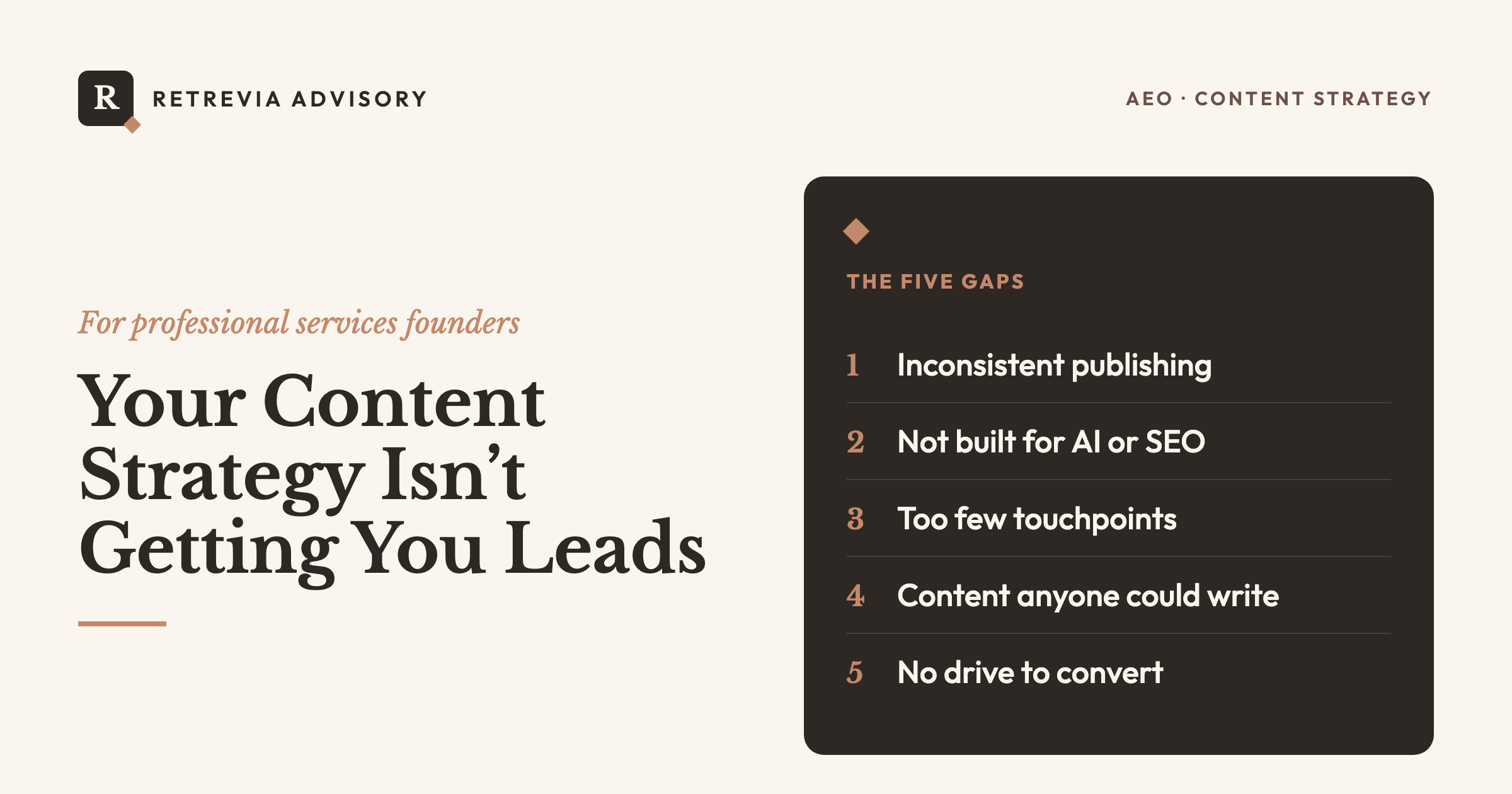
That’s not because content doesn’t work. It’s because of a set of identifiable problems that tend to show up together. Each of these alone can keep a firm with real expertise from getting leads.
Problem 1: You’re Not Publishing Consistently, Because You Don’t Have Time
You are running a services business. Client work comes first. Content is the thing that gets pushed when something more urgent lands. Which means it gets pushed constantly.
The result is a pattern most founders recognize: a solid post in January, nothing in February, two things in March, then a four-month gap. Then a LinkedIn post that says something like “I’ve been quiet, but I’ve been heads-down on some really exciting work.”
Here is the problem with inconsistency. Google’s ranking systems reward topical authority built through consistent, substantive output, and AI tools pull from sources with established credibility. Publish sporadically and you build neither.
Consistency does not mean daily output. It means a reliable cadence that your audience and search tools can track. What compounds is a sustained body of work: each piece builds on the authority of the last. A burst of posts followed by months of silence stalls, because the moment you go quiet you stop adding to it. For many founder-led firms, a sustainable rhythm of two pieces a month does more over a year than an occasional flurry that fizzles.
The fix is structural, not motivational. Batch. Schedule. Make content production a non-negotiable block on your calendar, not a task that floats.
Problem 2: Your Content Is Not Structured for AI or SEO
This is the gap most founders do not know they have. You can write genuinely good content and still be invisible in search, because the content is not structured in a way that search systems or AI tools can process.
What does that mean practically? A few things.
- Your headlines do not match how buyers search. If a buyer types “how to find a B2B marketing consultant” and your post is titled “Thoughts on Modern Marketing,” you are not answering their question.
- You are not answering specific questions. AI tools are increasingly citation engines. They look for content that directly answers a question a buyer is asking. Broad thought leadership that does not engage with a concrete problem rarely gets cited.
- Your site architecture makes it hard for crawlers to understand what you do. No internal linking. No consistent topic clusters. Pages that have not been touched in two years.
AI search optimization, sometimes called AEO (Answer Engine Optimization), requires that your content do more than exist. It needs to be structured so that a model can identify your area of expertise, extract a direct answer to a specific question, and attribute it to you. That requires intention in how you write, title, and organize your content.
Without that structure, you are writing for yourself. Not for the buyers searching for you.
Problem 3: You’re Not Creating Multiple Touchpoints
Most professional services buyers do not see one piece of your content and book a call. That is not how high-stakes purchasing decisions work. Research from Forrester found that B2B buyers average 27 interactions or touchpoints before making a purchase decision. They are doing due diligence, not impulse buying.
If you are only publishing in one place, at one cadence, in one format, you are creating one potential touchpoint. That is rarely enough.
The firms that generate consistent inbound are not producing more original content. They are distributing the same content across more surfaces. One strong blog post becomes:
- A LinkedIn post with a direct take and a link
- A newsletter issue that goes deeper on one point
- A short-form version catered to a target audience segment
- A reference piece that earns backlinks and AI citations over time
Each of those is a separate exposure point. A buyer who sees your name twice starts to recognize you. Five times and you are someone they already have a relationship with, even if they have never spoken to you.
Touchpoints also reinforce your signal in AI search. The more consistently your name appears across credible sources, with deep expertise, the more confident AI tools are in recommending you. One piece of content does not build that. A body of work does.
Problem 4: Your Content Could Have Come From Anyone
You can do everything in the first three problems and still come up empty. Publish on a schedule, structure every page for search and AI, distribute it across every surface, and watch it generate nothing.
Generic content does not compete. When your piece says the same thing everyone else says, a bigger firm’s version gets cited ahead of yours, because the model has no reason to prefer you. You also never surface for the problems buyers ask about, because you never answered them in a smart, helpful way. The content reads like it could have come from any firm in your category.
This usually traces to two things.
- You have no point of view. Most professional services content informs without committing to anything. It lays out the landscape, lists the considerations, and recommends nothing. The firms that win take a hard stance: they tell the reader what to do and why, even when staying neutral would be safer. The strongest form of that is action-oriented, a set of steps for handling a scenario or solving a problem that is hyper-relevant to a select audience. That works twice. It gives a human reader something they can use, and it makes you the source an AI tool pulls when a prospect asks how to solve that exact problem. This gives you another interaction with the reader.
- Your positioning is too broad. Content written for every possible buyer speaks to none of them. Narrow until it feels almost uncomfortable: one sector, one company size, one stage, one geography, or one situation you handle better than anyone. “Investor relations” is a category. “Investor relations for small-cap tech companies” is a position. The reader in that exact situation reads the second one and feels understood.
Both failures also cost you in AI search. AI tools prefer to surface firms with obvious expertise over generalists, and that is where the opportunity is for a smaller firm to show up next to, or instead of, a larger one. Committing to one area and a single position is what leads to showing up or being cited in AI responses.
Problem 5: There Is No Drive to Convert
Here is the problem that sits underneath the others. A buyer can find your content, read it, agree with every word, then close the tab and do nothing, because nothing in the piece moved them to act.
This is the gap between visibility and leads. Visibility gets people to your content. A reason to act, and a next step to take, is what turns a reader into someone you can talk to. Without it, you are generating traffic, not pipeline.
Creating that action is not an aggressive sales pitch. For professional services, it’s usually a low-pressure next step that fits where the reader is: a relevant offer like a benchmark or checklist, a link to go deeper on the same topic, or a reason to reach out now rather than someday. One next step per piece, pointed at the reader who just finished it.
The System That Gets Smaller Firms Cited in AI Search
Any one of these problems limits your results. You cannot structure your way past inconsistency, distribute your way past generic content, or convert a reader you never reached.
The firms generating inbound through search, including AI tools, have solved all of it. They publish on a schedule. Their content takes a position and answers niche questions. They show up in enough places that buyers feel like they already know them. And every piece gives the reader a next step. That is a system, and it is buildable, even without a dedicated marketing team.
But it only compounds if you measure what it produces, and most firms skip that. They publish and distribute, yet never track which pieces get found, get cited by AI tools, and lead to a conversation, so they cannot tell a strong piece from a weak one or do more of what works.
Measurement is what makes the system work for you. A specific, well-structured piece earns visibility, that visibility builds authority, and authority makes the next one easier to surface. Done consistently, that loop is how a small firm gets surfaced in AI search ahead of competitors many times its size. Almost no one is building it yet. The firms that move first will be the ones AI tools surface when their buyers go looking, and the rest will wonder why their content never turned into clients.
For the full picture of what actually earns AI visibility, from picking your specialty to proving expertise to building off-site signals, see AEO for Founder-Led Consulting Firms: The Complete Guide to AI Visibility.
If you want to understand exactly where your firm stands across all of these, Retrevia’s Brand Visibility Audit is designed for this. You walk away with a clear picture of what is working, what is not, and what to fix first.
Frequently Asked Questions
Why is my content not generating leads even though it is good?
Good content can still be invisible. The usual cause is not quality but the system around it: publishing in bursts instead of on a schedule, writing in a way search systems and AI tools cannot parse, putting each piece in only one place, a piece that could’ve come from any firm, and no reason for the reader to act. Most founder-led firms have several of these gaps at once.
How often should a professional services firm publish to see results?
Consistency matters more than volume. For most founder-led firms, if publishing one or two substantive pieces per month on a reliable schedule is sustainable, then start there. A steady rhythm in a focused topic builds topical authority and a body of work over time. That accumulated authority is what search engines and AI tools actually reward, not the cadence itself.
How do AI tools decide which firms to cite?
They favor firms with well-defined expertise and content structured so the answer to a question is easy to extract and attribute. That means a defined point of view, consistent coverage of a topic, supporting signals like schema markup (structured data that labels what a page is about), and a presence across credible third-party sources.
How do you generate leads with content marketing?
Publish consistently, take a clear position on a narrow topic, distribute each piece across several surfaces, and end every piece with one next step. Visibility alone just produces traffic; the next step is what turns a reader into a conversation.
What is answer engine optimization (AEO)?
Answer engine optimization is structuring your content so AI tools like ChatGPT and Perplexity can identify your expertise, extract a direct answer, and attribute it to you. It’s the AI-search counterpart to SEO, and for smaller firms it’s often where the opening is to show up next to, or instead of, much larger competitors.
RETREVIA ADVISORY
Your next client is searching now.
Find out if your firm shows up.