June 25, 2026
SEO Winners Understood How Buyers Searched. AI Search Winners Will Understand How Buyers Ask.
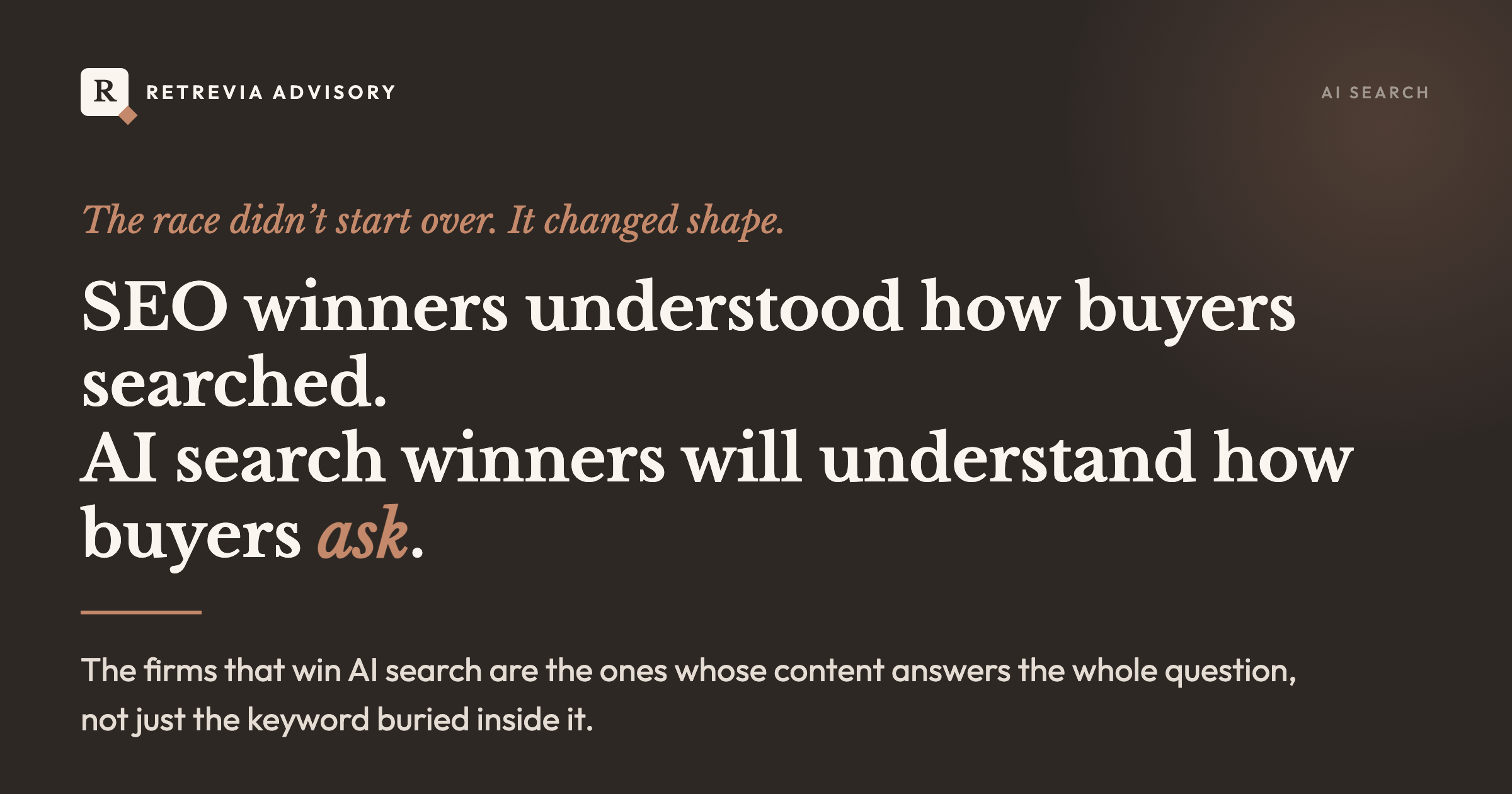
SEO winners understood how their buyers searched. AI search winners will understand how their buyers ask. For founder-led professional services firms, the recommendations are still forming, which means the window to become the answer AI tools cite is open right now.
A few months ago I talked with a founder who told me she missed the boat on SEO. By the time she was ready to make the investment, the front page was taken. So she wrote it off. Then she asked me whether AI search was just the same race starting over, one she had already lost.
It isn’t. And the reason it isn’t is the whole point.
The firms that won search over the last decade were not always the ones with the biggest budgets. They were the ones that understood how their buyers searched. The firms that win AI search will be the ones that understand how their buyers ask questions.
It sounds like a small distinction. It isn’t.
The Real Lesson From SEO Was About Language, Not Tactics
Our previous firm, Clermont Partners, called itself a “financial communications firm.” Accurate. It was also a phrase almost nobody was typing into a search bar. The buyers who needed exactly what the firm did were searching three plain words: “investor relations firm.”
So we changed the language to match the words their buyers actually used. Not the tactics. The language. The inbound pipeline grew. Ultimately to 50% of our business.
That was the real lesson, and most firms still miss it. You describe yourself one way. Your buyer describes the problem another way. The gap between those two descriptions is where your leads quietly disappear.
AI search makes that gap wider, not narrower.
Buyers no longer type a flat keyword. They ask a full question. “Who are the best communications firms for a healthcare company about to go public?” That sentence carries context a keyword never could. Who they are. Their situation. What they actually need.
A firm that matched the old keyword can be left out of the new answer entirely. The firms that win are the ones whose content answers the whole question, not just the keyword buried inside it.
AI Search Is Still Deciding Who Gets Recommended
Here is the part worth paying attention to. The recommendations are still forming.
Yes, some established firms already show up often. They earned it through years of authority and coverage, and I am not going to pretend otherwise. But AI tools keep weighing new signals as they appear. The firms showing up today have a real advantage. They do not have a permanent claim on it.
The category is still being built. That is a very different situation than a first page of Google that took someone a decade to lock up.
The Opportunity Is Bigger Than a Ranking
Most firms hear all this and think, “I need to rank.” That is the wrong frame.
A ranking is a position. A recommendation is trust.
When a buyer asks an AI tool who to hire, the tool is not sorting links. It is deciding who to put its name behind. It looks for evidence of expertise, specialization, credibility, and current knowledge, then it hands the buyer a short list.
That is the real shift. Not from page two to page one. From being found to being chosen.
Why the Window Is Still Open
Traditional search rewarded accumulated authority. The longer you had been ranking, the harder you were to dislodge, which made catching up slow and expensive.
AI search still values authority. But it also weighs current expertise, and the information these tools pull from changes constantly. Recently published work tends to earn more citations than older pages, and that value fades over roughly a year. Every article, interview, podcast, and useful insight becomes a fresh signal you can earn right now.
That is good news if you run a founder-led firm. You may never have outranked a larger competitor on domain authority alone. You do not have to. A clear, focused point of view for a niche audience can earn the recommendation ahead of, alongside of, or in place of a bigger, more generic competitor.
The work you do this quarter compounds.
What This Means for Founder-Led Firms
Most founder-led firms grew on referrals. Nothing wrong with that. Referrals are the highest-trust channel you have. They also only reach people already connected to your network. And they are only one sales channel.
The buyers asking AI tools who to trust have never heard of you. They’re asking who can help. The question is whether your firm shows up in those conversations.
This has quietly become the next growth problem for professional services firms, whether or not they’ve made past investments in SEO. These firms have to understand what their buyers are asking, whether AI tools currently treat them as a credible answer, and what it takes to become the recommendation.
The firms that won SEO were not always the biggest. They were the ones that understood how buyers searched. The firms that win AI search will be the ones that understand how buyers ask.
You did not miss this one. The recommendations are still being written.
Frequently Asked Questions
Is AI search replacing SEO?
No. It builds on the same signals and adds a new layer: citations, entity recognition, structured content, and third-party authority. Both matter, and they reinforce each other.
How does AI decide which firms to recommend?
Relevance and evidence of expertise, not company size. The tools look for a clear specialty, consistent positioning, and credible, current proof that you do the work.
Why are smaller firms showing up in AI search?
Focused content and clear authority in a niche can outweigh size. A founder-led firm with a sharp point of view is often easier to recommend than a large firm that covers everything.
How is AI search different from traditional search?
Traditional search returns links to evaluate. AI search returns a generated answer with a short list of names. Whether you show up now depends on being cited inside that answer.
Does fresh content really matter?
Yes. Current expertise is a signal in its own right, not just historical authority. Recent, specific work earns citations that older, generic pages do not.
What should professional services firms focus on first?
Your baseline. Find out whether AI tools mention you, your competitors, and what sources AI search tools are pulling from to form their recommendations. Then build around the gaps.
RETREVIA ADVISORY
Your next client is searching now.
Find out if your firm shows up.