September 1, 2026
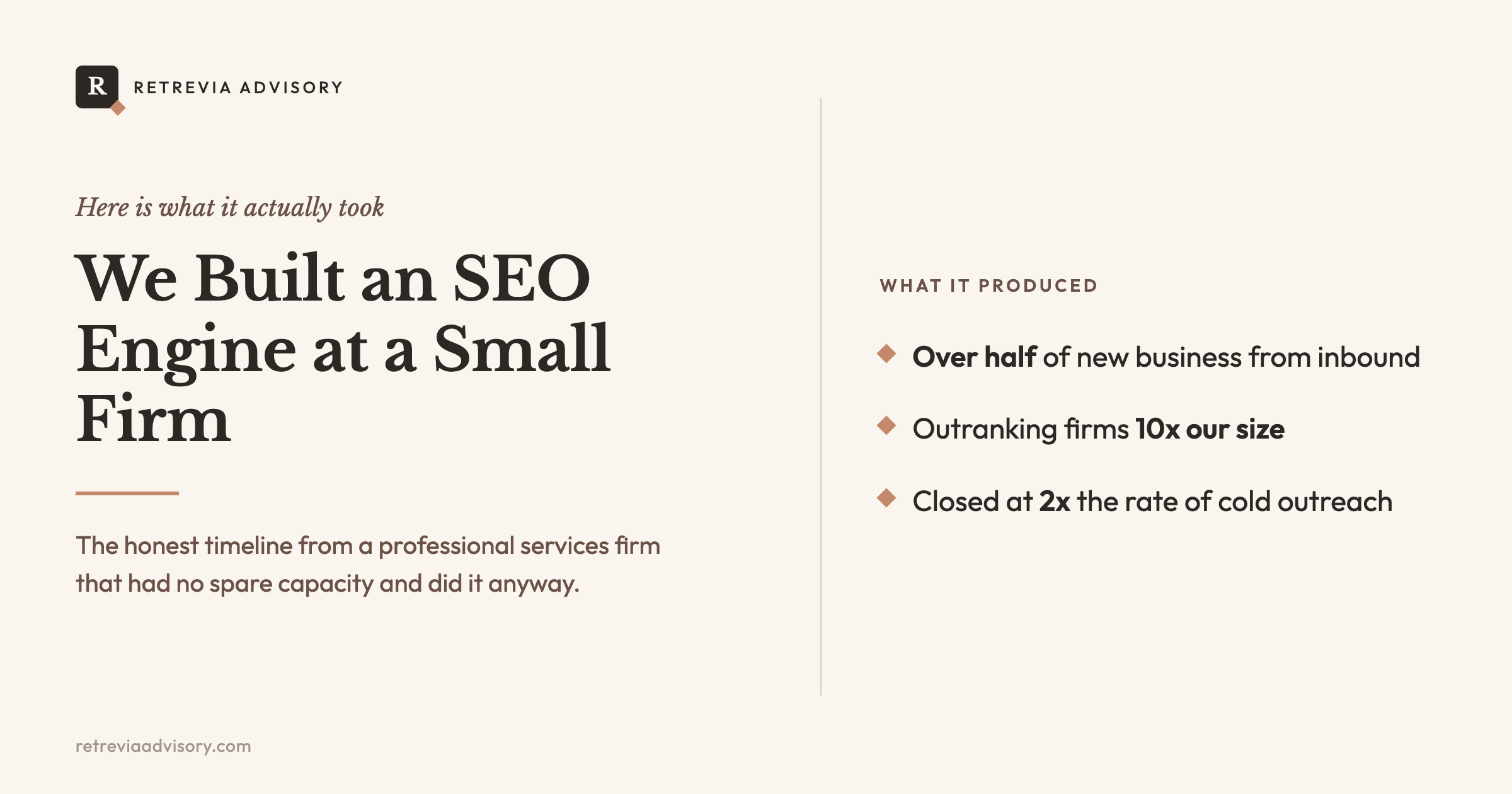
We Built an SEO Engine at a Small Firm. Here's What It Actually Took.
This is the real timeline, what it produced, and what we would do differently today.
In 2017, I attended an SEO workshop on behalf of Clermont Partners, the boutique consulting firm where I ran marketing. The goal was to create a plan we could follow to rank #1 on Google. I came back knowing that for a firm of fewer than ten people, with limited resources outside of client delivery, it would be a big ask to execute.
In the back of our minds we knew we should do it, but we didn't. Committing to a consistent publishing cadence on top of a full client load felt overwhelming. As other professional services businesses know, client work always comes first.
About a year later, there was a not-so-uncommon moment when our pipeline looked bleak. Referrals went dry. We were desperate for more clients.
A business advisor of ours pushed us to pursue SEO again. It still sounded scary. The big household names in our industry were on the first page of Google. At the time, 100% of our new business came from our founders' networks and events we physically attended. But we were at a sticking point. Our business couldn't wait for an intro email to magically appear in one of the founders' inboxes.
When we did publish content, it was smart. We knew it was better than what anyone else in our field was saying. The problem was that we didn't know who, or if anyone, was reading it.
What We Invested
Instead of sponsoring another conference that year, we put the money into our online presence. We hired an agency, revamped our entire website, changed our messaging and positioning, and committed our team's time to pursuing an SEO strategy as a key part of our marketing. We published roughly 3-4 articles per month on our website, distributed content on LinkedIn, and built and nurtured our email list.
How Long Does SEO Take to Work?
For us, six months before anything landed, and about three years for it to become a huge chunk of our pipeline. Our first inbound lead from the website came in month 6. Here is what each month actually looked like.
- Month 1: started seeing who was engaging with our content (the numbers were humbling).
- Month 2: a few more opens on our emails.
- Months 3, 4, and 5: a few more clicks to our website.
- Month 6: our first inbound lead from the website.
After that, it picked up.
That was the timeline in 2018, and the slow part of it was Google. Ranking gates on accumulated domain authority, which is why nothing moved for months no matter how good the work was. AI search does not gate the same way. The engines weigh whether a page actually answers the question in front of them, not necessarily how long the domain has been earning trust, which removes the slowest step in that old curve. The tradeoff is that AI visibility is less stable than a Google ranking and it shifts as the engines re-crawl. What has not changed is the asset underneath. Both channels read the same thing: expertise you have actually published, on a site a crawler can read. That still takes time to build, and it is the reason to start now rather than later.
Our homepage, services pages, and thought leadership articles started ranking on the first page of Google. In some cases, we were outranking competitors 10x our size.
Our audience universe was small. Like 2,000 companies small. So some of our keywords had 90 searches per month while others had 1,200 searches per month. In the grand scheme of things, these were low-volume searches.
But our client projects started at around $50,000 and our retainers ran about $120,000 annually. Meaning, even getting one client through our online search strategy per year would make the investment worthwhile.
By year three, our marketing strategy was sourcing over half of our new business calls. People were reading our content. Sometimes for a few months. Then, when they needed someone, we got the call. Not because we were the biggest firm with the best reputation. But because we were top-of-mind and had already established trust before they ever picked up the phone.
Those calls were also better calls. Leads that found us through search closed at twice the rate of our cold outreach, because the person on the other side had already read our thinking and vetted us before we ever spoke. Over the four years we ran this, the firm grew from $2 million to $7 million in revenue. Search was not the only reason, but it was the reason our pipeline stopped depending only on who we happened to know.
What SEO Looks Like for B2B Services Firms
There are components of that strategy that still work today. However, the search landscape is changing. Your ideal clients are no longer starting with Google and landing on your website. Agencies and service providers are now the single most researched category in AI, at 51%, ahead of every software category in Semrush's 2026 study of B2B buying.
SEO is not dead. SEO and AI search are both critical parts of getting discovered by your target audience, and they run on the same work.
Your website is a credibility layer. Both AI assistants and humans review your website to vet you. It offers you the opportunity to establish authority and to sell your firm when you're not in the room. But it's also only one of the many sources that AI tools scrape when a buyer is talking to ChatGPT about a problem your business can solve for them.
A technically sound website where a business has established topical authority and publishes valuable content to the user is still critical in the B2B services world.
What We'd Do Differently in Our Search Strategy Starting Today
In 2018, the playbook was: rank, get the click (Google, LinkedIn, email), get the user to our site, prove our worth, convert. In 2026, that approach works with a few adjustments: get recommended or found (AI assistants, Google, LinkedIn), website, discovery call.
That changes the strategy. Publishing consistently on your own site is still the foundation. Depending on your industry category and niche audience, other platforms sway whether you get recommended or not. That could include LinkedIn, industry publications, news, podcasts, or directories. The firms showing up both in AI answers and on Google are those whose expertise is evident in places they do and don't control.
Five Things You Can Do This Week
What does this mean for you? The starting line has changed. Your discoverability strategy should be built from a position of AI search optimization and SEO. Here are five things you can do this week:
- Test how your firm appears in AI search results. Ask questions that your buyers ask when they need your help to the AI tools they're using, ChatGPT, Claude, Gemini, Google AI Overviews, Copilot. Do this in both logged-in and logged-out versions of the tools if possible and get specific with your prompts. LLMs know more about the user and use that context when answering questions. Which tools are recommending your firm? Does it show up at all? If so, how are you showing up? Is the messaging about your company consistent?
- Track what's measurable. Look at your website's analytics. Check your Google Search Console or Google Analytics account to see how your website is performing and what keywords and queries are trending upwards and downwards. Do any of them match the topics you want to be showing up for? Is this something you're tracking on a monthly basis? If not, start now.
- Know where you're harnessing engagement. Whether it's emails or LinkedIn, or both, you should be tracking your audience engagement. How does the trendline look? What topics are resonating based on the data? Create more of what's contributing to engagement. Also track this monthly.
- Take inventory of your third-party presence. When's the last time your firm was mentioned in a media outlet? That doesn't have to be the Wall Street Journal. Think industry or local press coverage or a podcast. Are you listed in relevant directories? AI assistants scrape all of these. They also prefer recency, so add this to your strategy.
- Pick one topic to write about this week. Based on your findings in the steps above, choose a topic that addresses a problem you hear from your clients and prospects or that you've had proven engagement on. Publish an insight on your website and talk about it on LinkedIn or within a third-party outlet. This is one step that will support your discoverability.
You need to know how different AI tools and Google are all currently talking about your firm (or why they're not). Then, map out how you want them to be talking about you. Start with the platforms you can control: your website, thought leadership, and LinkedIn. Fix your messaging, post about the topics your buyers are asking about, and make sure you have a sound technical foundation on your website to allow for AI and Google crawlers to easily scrape your content. This will inform your strategy moving forward.
Curious where to start? We're here to help. Our Baseline Diagnostic can map out exactly how you are showing up in AI search results and Google today, and help you map out the strategy to get recommended and show up where your ideal clients are already looking. Reach out today to see where you stand.
RETREVIA ADVISORY
Your next client is searching now.
Find out if your firm shows up.