May 12, 2026
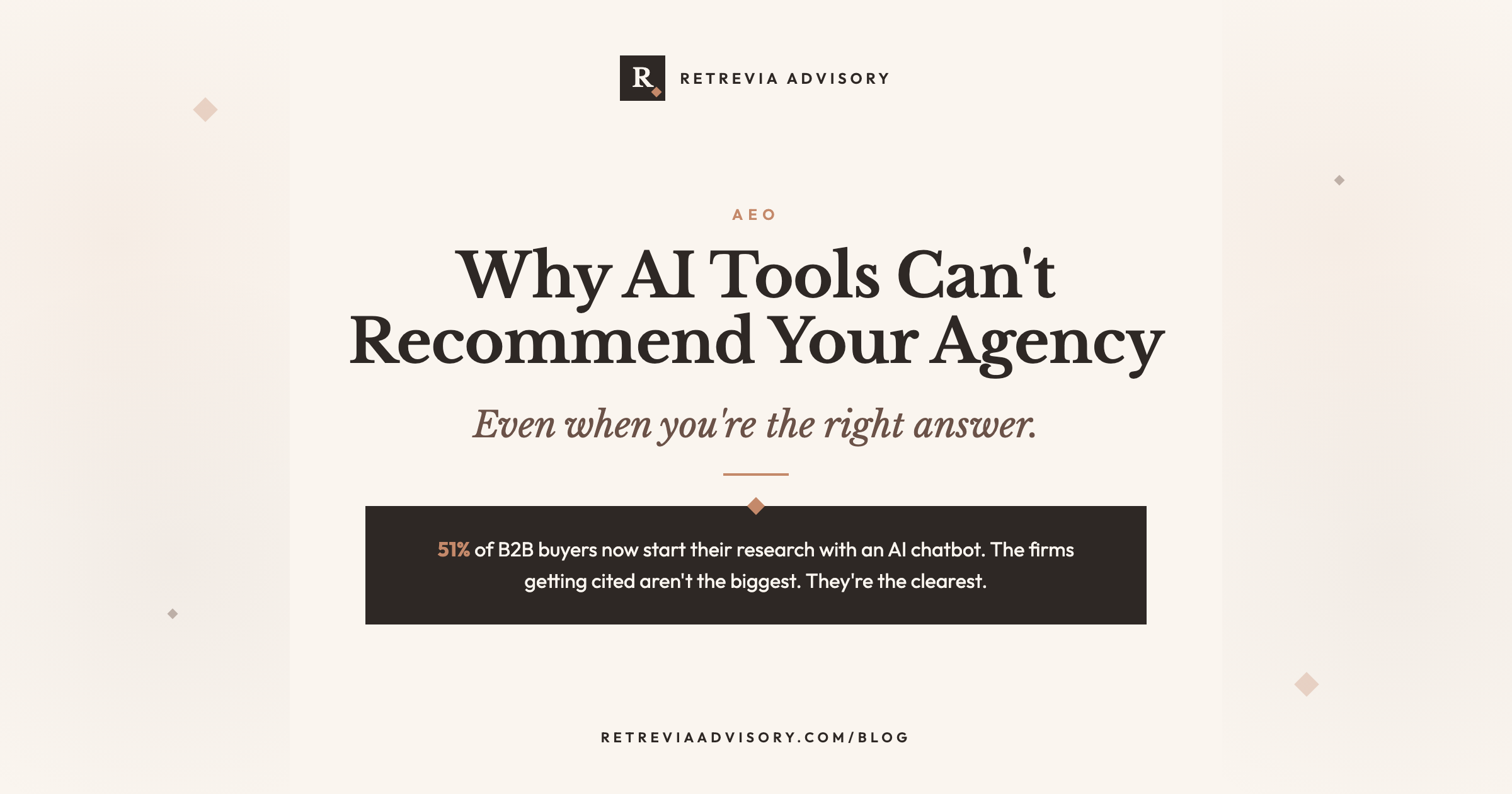
Why AI Tools Can’t Recommend Your Agency (Even When You’re the Right Answer)
Even When You're the Right Answer
Here is a number worth sitting with: 51% of B2B buyers now start their research with an AI chatbot instead of Google. Eleven months ago, that number was 29%.¹
That is not a gradual shift. That is a change in how decisions get made, in real time. And if you run a consulting firm, agency, advisory firm, independent consultancy, coaching practice, or any kind of B2B services business, it has direct implications for how your next client finds you.
There Is No Page Two in AI Search Results
When a buyer asks ChatGPT, Perplexity, or Claude for “the best consultant for [their specific problem],” they do not get ten blue links to evaluate. They get a synthesized answer. A short list of names the AI model has decided are credible, specialized, and relevant.
Your firm is either in that answer, or it is not.
There is no scrolling. No second page. No “we’ll optimize and move from position 9 to position 4.”
If you’re not included, you’re effectively invisible.
Your firm is being evaluated before you ever speak to a client
Most of us built our businesses on referrals and relationships. That is not going to change, and it shouldn’t. Referrals remain the highest-trust channel most founder-led firms will ever have.
But referrals have a ceiling. You can only grow as fast as your network grows, and your network only grows as fast as you can nurture it.
AI visibility is a second engine that runs in parallel.
It doesn’t replace relationship-driven growth. It extends it. It puts you in front of buyers who aren’t in your network, don’t know your name, but are actively searching for someone with your exact expertise.
That’s the shift.
It also changes when your firm is evaluated. In the old model, you found out about a prospect when they filled out a form, replied to an email, or were introduced through a referral.
In the new model, they’ve already asked an AI tool who to consider, read what came back, clicked into a handful of firms, and formed an initial opinion.
By the time you hear from them, you’ve already been shortlisted, or ruled out, without ever knowing you were in the running.
This is a fundamentally different dynamic.
Your firm now has to earn credibility before you’re ever in the room.
Which Agencies AI Search Results Actually Recommend
When it comes to AEO (answer engine optimization), most firms assume this is a visibility problem. It’s actually a clarity problem. That’s exactly why most consulting firms aren’t showing up in AI search results in the first place. AI systems don’t “discover” firms the way humans do. They pattern-match. They look for:
- Ownership of a specific subject matter
- Consistent language
- Strong signals of expertise
- Content that demonstrates a clear, distinct point of view
If your firm:
- Spreads its expertise across too many areas
- Uses vague positioning
- Publishes generic content
then the model can’t confidently place you. And if it can’t place you, it won’t recommend you.
The Mistake Most Firms Make with AI Content
The obvious response to this is to produce more content. More blog posts, more LinkedIn activity, more volume. Some founders are outsourcing this to AI tools entirely and publishing 20 articles a month on every topic tangentially related to their work.
That is not the answer. For services businesses, this is exactly the wrong move.
Here is why. Professional services buyers are not making $39 purchasing decisions. They are hiring someone for significant engagements with real stakes. When they read your content, they are not just absorbing information. They are asking, “Do I trust this person with this problem?”
Generic content answers that question with a no.
AI tools are also getting better at detecting generic content, not worse. Google’s March 2026 update² made clear that high-volume, AI-generated content that does not add genuine value will be deprioritized and potentially marked as spam.
When deciding what to cite, ChatGPT and Perplexity are increasingly prioritizing:
- original perspective
- specific claims
- experience-backed, verifiable insights
The firms that win AI visibility are not always the ones publishing the most content. They are producing better content. Specific content. Content that only they could have written.
What Actually Drives Inbound Growth for Agencies
I know this because I’ve lived it.
At Clermont Partners, my co-founder and I made a serious investment in SEO. Not a casual one. We hired people and brought in an agency. Then we rebuilt our positioning through a complete rewrite of our market materials, our website, and our thought leadership content. It took three years of hard work and consistent investment before we saw the full payoff.
But when it paid off, it really paid off.
We landed on the front page of Google for our target search terms, and often in the top two spots. Buyers looking for firms with exactly our expertise were finding us before they ever heard our names through a referral.
By the time we sold the firm, 50% of our new business was coming from inbound inquiries. People who found us, vetted us, and decided to reach out. We were not chasing them. They were coming to us.
That is what happens when you make your expertise easy to find and easy to trust. The referral business does not go away. It gets a second engine running alongside it.
What made that work was clarity paired with a consistent body of thought leadership built on real points of view. We weren’t publishing to stay active. We were publishing to make our perspective and our expertise easy to understand, trust, and recommend.
Over time, that created a clear signal:
- what we did
- who it was for
- and how we thought about the problem
That’s what both buyers and search systems respond to.
The channel has shifted since then. Google search is no longer the only place buyers look. AI tools are increasingly where the research starts. But the underlying principle is identical: if buyers cannot find you when they are actively looking for someone like you, you are leaving serious revenue on the table.
Why Founder-Led Firms Have the Advantage in AI Search
Here is what most founders do not realize about the AI visibility race: the firms with the biggest marketing budgets are not set up to win it.
Large agencies and consulting firms are structurally disadvantaged in AI search. They cover everything, which means they do not own anything. Their content is written by a committee, so it rarely carries a strong point of view. Their subject matter is spread across hundreds of practice areas, which dilutes their credibility across all of them.
Which means they rarely show up as the best answer to a specific problem. AI tools are not looking for the biggest firm. They are looking for the clearest match.
That favors:
- focused firms
- strong, consistent points of view
- and distinct expertise
This is genuinely good news if you run a founder-led practice.
The depth of expertise you’ve built in a specific area (how you think about the problem, the frameworks you use, the way you explain it) is what AI systems are designed to surface. It’s also what buyers are actually looking for when they decide who to hire.
That’s citable content.
The thing large firms spend millions trying to manufacture (credibility and clarity) is the thing you already have.
How to Start Showing Up in AI Search Results
If you have been putting this off because it feels like one more thing on a list that is already too long, start with one question: what problem do you solve better than almost anyone else?
The answer to that question is your specialty. Write one clear sentence about it. Use that sentence everywhere your firm appears online:
- your website
- your LinkedIn
- your bios
- your directory listings
Make it easy for AI tools to understand exactly what you do.
Then write something substantive about it. Not a tips list. Not a broad overview. One piece of content that:
- is grounded in your actual experience
- takes a position
- speaks directly to the problem
Publish it. Build from there.
The Window Is Still Open
Most services firms have not done any of this yet.
They’re either relying entirely on referrals or producing content that doesn’t differentiate them. That won’t last. The firms that become clearly understood by both buyers and AI systems will be the ones consistently recommended.
We’ve seen how powerful that shift can be.
When your expertise is easy to find and easy to trust, the dynamic changes. Buyers come in already informed, already aligned, and already considering you alongside the alternatives that show up in their research.
At our previous firm, that shift reshaped where our growth came from.
Half of our new business came inbound. We didn’t have to chase it.
That’s worth building toward.
The question isn’t whether your next client is researching you. It’s whether you’re even in the set they’re considering.
If you want to understand how this works and what it would take for your firm to show up, we’ve broken down the full playbook here: AEO for Founder-Led Consulting Firms.
Frequently Asked Questions
Why are consulting firms not showing up in AI search results?
Most consulting firms are difficult for AI systems to confidently categorize. Their positioning is too broad, their messaging is inconsistent, or their content lacks a distinct point of view. AI tools prioritize firms with clear expertise signals and verifiable experience around a specific problem.
How do AI tools decide which agencies to recommend?
AI tools look for consistent signals across the web that help them understand what a firm specializes in, who it serves, and whether its expertise is credible. That includes website positioning, thought leadership content, third-party mentions, and clear topical authority.
What is AI visibility?
AI visibility refers to how easily your firm can be surfaced, cited, and recommended by AI tools like ChatGPT, Perplexity, Claude, and Google AI Overviews when buyers search for expertise related to your services.
Can smaller founder-led firms compete in AI search?
Yes. In many cases, founder-led firms have an advantage because they communicate with an original point of view and publish about more focused expertise than larger firms with broad service lines.
Does publishing more content improve AI visibility?
Not necessarily. Publishing large amounts of generic content often weakens differentiation instead of strengthening it. AI systems increasingly prioritize specific, experience-backed content that demonstrates clear expertise and a distinct perspective. For professional services, that is significantly more important than high-volume content that lacks substance.
RETREVIA ADVISORY
Your next client is searching now.
Find out if your firm shows up.
Sources
- G2, “The Answer Economy,” March 2026.
- Google Search Central, “March 2026 Spam Policy Update.”