August 11, 2026
Does AI Recommend Your Executive Coaching Practice?
Here's What 384 AI Answers Showed Us
Your best future client already asked ChatGPT who to hire. Someone else got recommended.
That is not a hypothetical. 51% of B2B buyers research services and agencies with AI, and 92% say AI has shaped their vendor shortlist. For executive coaches, that shortlist is being built before a prospect ever fills out a contact form, and most practices have no idea whether they are on it.
We ran the actual test: we asked ChatGPT, Claude, Perplexity, and Gemini 32 questions each and evaluated 384 answers. Here is what we found, and the five moves that come straight out of the data.
The Broad Question Is a Different Game Than the One You Can Win
Ask AI the plain category question and it names the same handful of giants every time. Ask it the way a real buyer actually talks and a completely different, more specific set of names shows up instead. That gap is the whole finding.
We asked AI search tools the plain category question, the way someone might type into a Google search bar, pre-AI search tools. Ask the broad query, "Who are the top executive coaching firms?", and the answers cluster around the same big names: Korn Ferry, The Leadership Circle, Noomii, CEO Coaching International, Zenger Folkman. Big brands, aggregators, and directories. A newer practice does not crack this list, and does not need to.
Then we asked AI search tools situational, problem-leading, high-intent questions. This is how many conversations start with AI search tools when your ideal client has an issue. Ask it the way a buyer actually talks, "I'm a solo consultant whose pipeline dries up whenever I stop networking. Who helps build consistent demand?", and the answer is Melisa Liberman, a solo coach for independent consultants. She also surfaced for buyer-specific queries around coaches for boutique consulting firms and consultant sales coaches. None of the household names from the broad query appear.
That gap is the whole finding. You will likely not win "top executive coaching firms," and chasing it is wasted effort. You win by being the clear, obvious answer to the specific problem your buyer actually describes.
The buyer-situation questions we tested fell into five patterns:
- A new or bigger leadership role: a newly promoted leader struggling to lead former peers, or a new executive finding their footing.
- A career crossroads: a long-tenured professional unsure they want the next promotion, or someone weighing a change of direction.
- A founder scaling past the bottleneck: a founder after a raise whose role has changed, or an owner whose business cannot run without them.
- A professional-services leader: a lawyer considering an in-house move, or an accountant weighing a shift into advisory work.
- A coaching or consulting practice trying to grow: a coach with inconsistent months, or one tired of relying on referrals.
Where AI Tools Actually Pull Sources From
AI does not invent recommendations. It pulls them from specific places on the web, information that is already stored in its training data, and the full breakdown is not what most practices assume. Coaches' own websites are the single biggest source, more than any other kind of source, at 39%, and it is the one you fully control. Your own site alone is rarely enough to get named, but it is still the fastest lever you have.
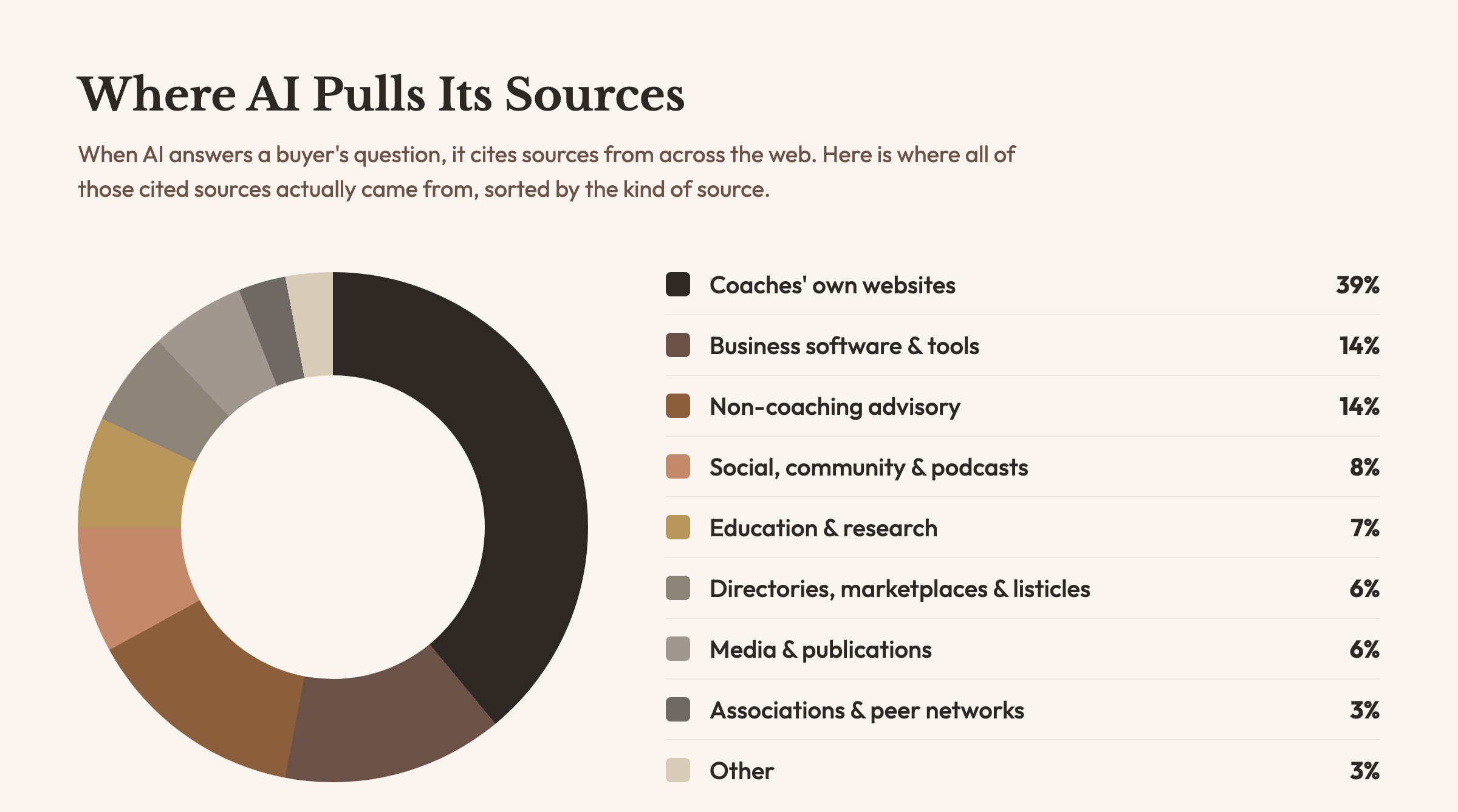
Two sizable slices, 14% each, are business software and tools and non-coaching advisory sources. Those are not places a coaching practice earns a mention by doing better marketing; they are a structural feature of how these engines answer any professional-services question. The pool actually worth fighting for is the rest of the map, the sources a focused practice can realistically earn:
- Social, community, and podcasts (8%). The articles, posts, and videos people publish on LinkedIn, YouTube, and podcasts.
- Education and research (7%). Academic and research-adjacent content, including studies and frameworks that get cited as background.
- Directories, marketplaces, and listicles (6%). "Best coaches for [your niche]" lists and the marketplaces AI trusts.
- Media and publications (6%). Being quoted or featured where your buyers read: Inc., Entrepreneur, a trade publication in your field, or a local business journal. Forbes and HBR count too, but you do not have to start there.
- Associations and peer networks (3%). Industry bodies and membership groups in your field, for example the ICF and SHRM.
- Other (3%). One-off pages that did not fit a larger source type.
Your own website is the first place AI looks, so it is the fastest lever you have. But your own site alone is rarely enough to get named. You get recommended by being clear and specific on your own site AND showing up in the third-party sources AI trusts. For a deeper breakdown of this source map across the broader professional-services category, see where AI search pulls its sources for services firms.
Five Moves You Can Make This Week
Every one comes straight from the source map. None requires you to outspend a big firm. They require you to be clearer and more specific than one.
- Get your positioning, messaging, and content right. Your website is the number one source AI reads, so start there. Say in plain words, on your homepage, about, and services pages, exactly who you coach and the problems you solve. Name a specific buyer and situation, not "leaders" in general. Then publish an article or blog that answers an exact question your buyers bring you, in the words they would use, not industry language. Specific, buyer-question content is exactly what AI reaches for.
- Get listed and vouched for where AI looks for validation. Beyond your own site, AI leans on third-party sources: directories and marketplaces, "best coaches for [your niche]" lists, media features, and peer networks. No single one is huge, but together they are how a practice that is not yet a household name can earn its way onto the shortlist. Claim and complete the profiles relevant to your niche, and pursue inclusion in the roundups and publications your buyers actually read.
- Use LinkedIn as a publishing engine. Across every AI tool, what got pulled from LinkedIn was published articles. The pattern we saw most was the LinkedIn articles AI cited had headlines that mirrored the buyer's exact question, like "How to build a business that runs without you" or "What's the difference between a life coach and an executive coach?" So, tighten your headline and about section to state your niche and align it with your website messaging, then publish LinkedIn articles and posts titled the way your buyers would phrase their problem. It's that content that AI cites. Most of the LinkedIn volume came through Perplexity, but the handful of citations from ChatGPT and Claude followed the exact same pattern.
- Build your media presence. Podcast interviews and publication features were cited across more than one AI tool. Get interviewed on the podcasts your buyers listen to, and pursue features or quotes in the publications they read. Inc., Entrepreneur, Forbes, a trade publication in your field, or a local business journal all count. If you are not doing this yet, start small: aim for one per quarter, an interview, a feature, or a podcast appearance. Third-party voices vouching for you travel further than your own claims.
- Make sure your website is set up for AI to read it. All of the above assumes AI can actually crawl and understand your site. Often it cannot: pages load slowly, the structure is messy, or the basic behind-the-scenes markup that tells AI what your site is about is missing. You do not need to become technical. But you do need someone to check that the back end of your site is clean and readable to the tools deciding who to recommend. This is the piece most practices cannot see for themselves, and the one most worth a second set of eyes.
One more thing worth checking while you are already in your own site: whether the pages are written to the person you would coach or to the person who actually hires you. Those are rarely the same reader, and the difference decides whether a buyer can defend you internally. We work through it in what buyers look for in an executive coach.
Worried that a narrow niche is too small to support your practice? Run the market size math first.
Score Your Own Practice
These five moves come straight from the source map above. We built a 9-question self-assessment across four dimensions, Known For, Visible, Trusted, and Chosen, that scores your practice out of 18 and tells you exactly which gap to close first.
Curious where you land? Take our quick assessment and find out where you stand.
RETREVIA ADVISORY
Your next client is searching now.
Find out if your firm shows up.