August 25, 2026
Executive Coaches: The Person Hiring You Is Not the Person You Coach
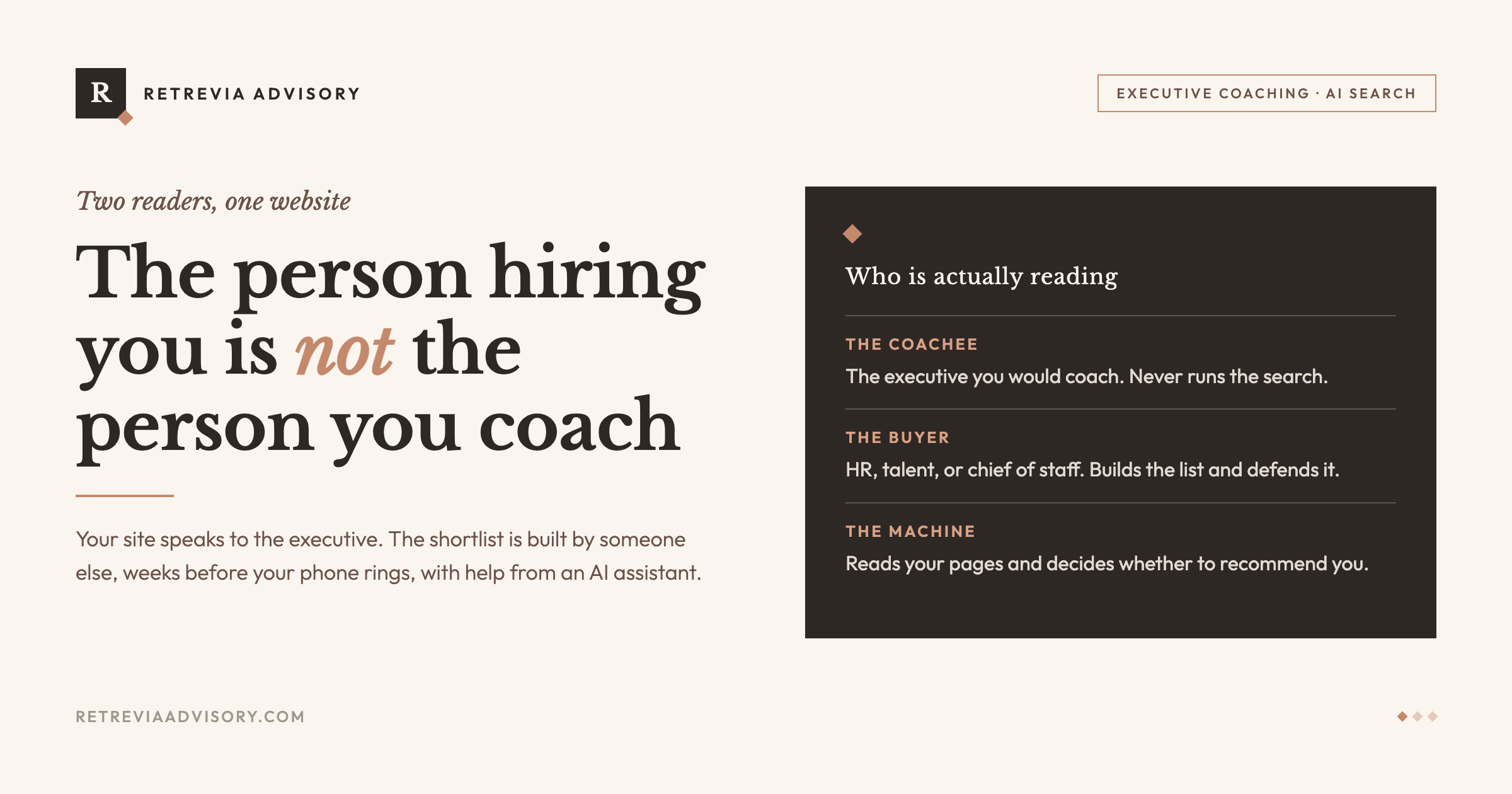
If you sell corporate engagements, your website is written to a senior leader, but the person deciding whether you get hired is usually someone else, and they're using an AI assistant.
Read your own site like a stranger
Give it ten minutes and read your own executive coaching site page by page, as though you had never met yourself. Almost every page is addressed to a senior leader. Your sales pitch is meant to work through pressure at the top, addressing the loneliness of the chair, the blind spots nobody will name, and the climb it took to get there. It is warm and thoughtful and aimed squarely at the wrong reader.
A corporate coaching engagement has two people in the buying decision, and they are almost never the same person. There is the coachee, the executive who will sit with you for six months, and there is the buyer, the person in charge of procuring you, who builds the candidate list, runs the interviews, makes the hire, and gets the invoice approved.
The buyer is a head of HR, a head of talent, an L&D lead, a chief of staff, or sometimes an executive assistant working from a one-line brief, and they are frequently more junior than the person being coached and have often never been coached themselves. They are running the search anyway.
The person doing the research is not the person you pictured
You can safely assume the executive being coached has never opened ChatGPT to look for a coach, and that assumption is fair, but it is also irrelevant, because she is not the one looking.
Across B2B generally, 51% of buyers now begin their research with an AI assistant rather than Google, and 69% say that guidance led them to a vendor they would not otherwise have chosen. So while the executive may never touch it, the person assembling her options almost certainly does.
Your buyer is not skeptical of AI, because they have been using it since their first job.
The list is finished before your phone rings
This is the part that should get your attention: 94% of B2B buying groups rank their preferred vendors before they contact any of them, and 77% end up buying from the vendor they favored on day one.
So the contest is not the intro call, it is a stretch of time weeks earlier that you never see, in which they type a question into a screen, get four or five names back with reasons attached, open each one in a tab, and read for about ninety seconds apiece.
That ninety-second read is the entire evaluation, not a pitch and not a chemistry check, and it is being done by someone who then has to walk into their CHRO’s office and defend a recommendation out loud.
If your site does not give them what they need to defend you, they move on, and you will never learn the engagement existed. And if your site never gave the AI enough to place you to begin with, you were never among the four or five names at all.
We ran that test ourselves across ChatGPT, Perplexity, Claude, and Gemini. Here is where AI pulled its answers from for executive coaches.
What the buyer is actually looking for on a coaching site
They are not looking for your philosophy of coaching, because they have read six versions of it already this morning and every version sounds alike. What they need instead are the unglamorous things that make a recommendation defensible:
- What the engagement actually is, meaning length, cadence, session format, and what happens in the weeks between sessions.
- What the sponsor gets to see, in the form of progress reporting that does not breach the coachee’s trust.
- Where the confidentiality line sits, stated plainly on the page, before anyone has to ask you for it.
- What happens if the match does not work, because every buyer has watched an engagement die of bad chemistry and has no interest in owning that risk twice.
- Who else like us you have done this for, described by company type, function, and situation rather than by name.
- Roughly what it costs, so they can put a number in a budget line before they have permission to ask you for one.
Now look at what your site actually gives them, which is a description of what coaching is, your credentials, a paragraph about presence and potential, and a photograph in a chair, none of which they can paste into an email to their boss. That is how you come off a list you never knew you were on.
Count the pages
Here is the ten-minute version of the exercise: go page by page and section by section, decide for each one whether it is written to the person being coached or to the person doing the hiring, and write the two numbers at the bottom.
Most practices come out lopsided, and ten to zero is not unusual. Each new page you add builds off the others and is aimed at the end client. It’s the person you have been imagining on the other end of the screen for the last five years, not the buyer trying to build a case for your hiring.
This is not a choice between the two readers
Do not swing the other way and turn your practice into a procurement document, because the executive still has to feel that you understand the seat she is in, and that content still earns its place.
The fix is not a different voice, it is different pages, because the coachee needs to feel recognized and the buyer needs to be able to justify the purchase, and one set of words will not do both jobs.
Three pages to write this month
- An engagement page that lays out what a typical coaching engagement looks like end to end and in specifics: how many sessions, over how many months, in what format, with what happening in between, including how the work starts and how it ends.
- A sponsor page that spells out what the person paying actually gets. The sponsor is usually the coachee’s manager or the HR leader whose budget covers the engagement. They are accountable for the outcome without ever sitting in a session. Cover kickoff alignment, the mid-point check, and the close-out conversation, and state exactly what is shared with them versus held in confidence. This is the page that separates a practice from an individual, and almost nobody has it.
- A who-we-work-with page built on client types and situations rather than testimonials, naming newly promoted VPs in PE-backed companies, partners stepping into firm leadership, or first-time functional heads inside a company that just doubled. Name the situation you fix in the words your buyer would use to describe their own problem.
Why this is a known-for problem, not a website problem
It would be easy to file all of this under website copy and hand it to whoever built the site, but that will not fix it, because the missing thing is not text, it is a business decision. That decision is to niche down, put out details of your engagement, and make a strong case for the exact type of client you can help.
The first question in our Authority to Revenue System is what your practice should be known for in the words your buyers use, which are not the words you use and not the words your coachees use, but the words typed by the person building the list. Until that is settled every page is a guess, and the AI tools reading your site end up with the same problem the buyer has, which is that they cannot place you, so they do not name you.
Referrals hide this entirely, because a referral arrives already vouched for by someone the buyer trusts, so the vetting gets skipped and the gaps on your site never cost you anything, but the moment you go looking for growth outside your own network those gaps are all that is left. That is the referral ceiling doing its quiet work.
Referrals do not require you to be legible to a stranger, and everything else does.
So start with the page count, because ten to zero is a finding, and what it tells you is that the practice has been marketing to the person who benefits from the work rather than the person who authorizes it, which is the most common reason a good coach with a strong reputation cannot get on a list she should be topping.
Where does your practice stand?
A strong website can help a buyer understand what you do. But that alone does not tell you whether your firm is set up to consistently reach buyers who have never heard of you.
If most of your business still comes from referrals and existing relationships, the bigger question is whether you have a system for becoming visible, building trust, and creating demand outside your existing network.
Our Referral Ceiling Assessment helps you see where that system is strong, where it is thin, and what may be limiting your ability to grow beyond referrals.
Frequently Asked Questions
Who actually hires an executive coach in a corporate engagement?
Usually not the executive being coached, because the search and the shortlist are typically run by a CHRO, a head of talent, an L&D lead, or a chief of staff, often with an executive assistant handling the initial research. The executive being coached is frequently brought in only at the end, to meet the final two or three candidates.
What should you look for in an executive coach?
Look past credentials and philosophy, which nearly every coach presents in similar terms, and evaluate the things that make a choice defensible to other people. Ask how the engagement is structured end to end, how many sessions over how many months and in what format. Ask what the person paying receives and when, and where the confidentiality line sits between the coachee and the sponsor. Ask what happens if the coach and the executive turn out not to be a fit. A coach who has already answered those questions in writing is easier to evaluate, and easier to recommend internally, than one who answers them only on a call.
How do you choose between executive coaches who look similar?
Separate them on specifics rather than on tone. Most coaching sites describe a philosophy of coaching, which is where they converge and start to sound alike. The useful differences are in who each coach names as their typical client situation, whether they work with newly promoted VPs, founders after a raise, or first-time functional heads, and how precisely they describe that situation in the words a buyer would use. A coach who names the exact problem you are trying to solve is a stronger candidate than one who describes leadership in general.
What should a coaching website include for the buyer, not the coachee?
Engagement structure and length, session format, what the sponsor receives and when, where the confidentiality line sits, what happens if the coach and coachee turn out not to be a fit, the client types and situations you work with, and enough pricing signal for them to place you in a budget range without calling you first.
Is it too late if the buyer has already built a shortlist?
Largely yes, because 94% of B2B buying groups rank their preferred vendors before contacting any of them and 77% buy from their day-one favorite, so the work that determines whether you are on the list happens before any contact, which is exactly why the site has to answer the buyer’s questions without you present.
Does this apply to solo coaches or only to coaching firms?
It applies to any practice selling corporate engagements, and it is more urgent for solo coaches. A single-person practice usually publishes the least buyer-facing information, and that creates two problems at once: the AI tools have little to work with when deciding whether to name you at all, and if they do name you, the buyer lands on a site that gives them nothing to take to their boss.
RETREVIA ADVISORY
Your next client is searching now.
Find out if your firm shows up.