July 30, 2026
The Referral Ceiling
Referrals built your firm. They will not double it.
Start with one question. How many of your last 10 clients came from a referral or an existing relationship?
If the answer is eight or more, you do not have a marketing problem. You have a client ceiling. Your growth is capped at the size of your network, and your firm's value is capped at your rolodex.
That is not a knock on referrals. They are the highest-trust channel a founder-led firm will ever have. They close faster, they price better, and they arrive already sold on you. Every good professional services business is built on them. The problem is what happens when you decide to double your business.
The Ceiling Is Math, Not Effort
A referral engine grows at the rate your network grows, and your network grows at the rate you can meet people and stay useful to them. That runs on your calendar, and your calendar does not scale.
So the math goes like this: more revenue requires more relationships, more relationships require more of your time, and your time is already spent delivering the work that produces the referrals in the first place.
You can work your network harder for a quarter. You cannot work it twice as hard for three years.
This is why so many founder-led firms plateau at a number and sit there. Nothing broke. The founder did not get lazy. They maxed out the only channel they had. Working the ceiling harder does not raise it. It raises your cost of staying in place.
The Second Cost Nobody Prices In
There is a version of this problem that shows up years later, when you go to sell. If every client relationship traces back to you personally, you have not built a firm. You have built a very good job with employees attached.
A buyer looks at founder-concentrated origination and sees risk, because the asset walks out the door when you do. A firm where a meaningful share of new business arrives from people who have never met you is a different asset entirely, not because the revenue is better, but because it is repeatable.
Non-referral revenue is not just growth. It is enterprise value.
The Buyers Outside Your Network Are Already Shopping
The B2B buyer journey changed. The buyers who do not know you are not waiting for an introduction. They are building a shortlist without you in the room.
- 51% of B2B buyers now start their research with an AI tool instead of Google. (G2, The Answer Economy Report, March 2026)
- 92% of B2B buyers say AI has shaped their vendor shortlist, and 83% say it influenced their final decision. (Semrush, July 2026)
- Agencies and service providers are the #1 category B2B buyers research using AI tools, ahead of software, marketing tools, and enterprise platforms. (Semrush, July 2026)
Read those three together. The shortlist gets built early, it gets built from sources beyond your website, and the firm sitting at the top of it on day one usually wins. If you are not named during that research, you never find out the deal existed.
The Specific Searches Are Wide Open
We ran a benchmark in July 2026: 32 real buyer questions, sampled across ChatGPT, Perplexity, Claude, and Gemini, for 384 total answers in one professional services category.
Broad questions went to a handful of national names. Predictable. Those firms have decades of citations behind them, and you are not going to out-muscle them on "best executive coaches."
But the answers came apart the moment a buyer added a detail. Industry. Role. City. Ask about PE-backed leadership teams in New York, or tech founders in San Francisco, and the national brands dropped out. A small set of specialist firms took their place, and almost none of them had claimed those niches on purpose. They got there by accident.
Specificity is your strategy. That is the opening. It does not stay open.
Publishing More Is Not the Answer
The reflex is to produce more: more posts, more volume, more presence. For a professional services firm, that is the wrong move.
Your buyer is not making a $39 decision. They are deciding whether to hand you a problem that matters, and when they read your material, they are asking one question: do I trust this person with this? Generic content answers that with a no.
It also fails on the other side. AI systems recommend what they can corroborate, and corroboration comes from third-party sources: directories, industry lists, peer networks, publications, podcasts. Across a handful of our benchmarks in the professional services categories, third-party sources accounted for roughly 60% of the citations behind AI recommendations. That is the realistic path for any firm that is not already a household name.
Volume does not produce corroboration. Specificity and proof do.
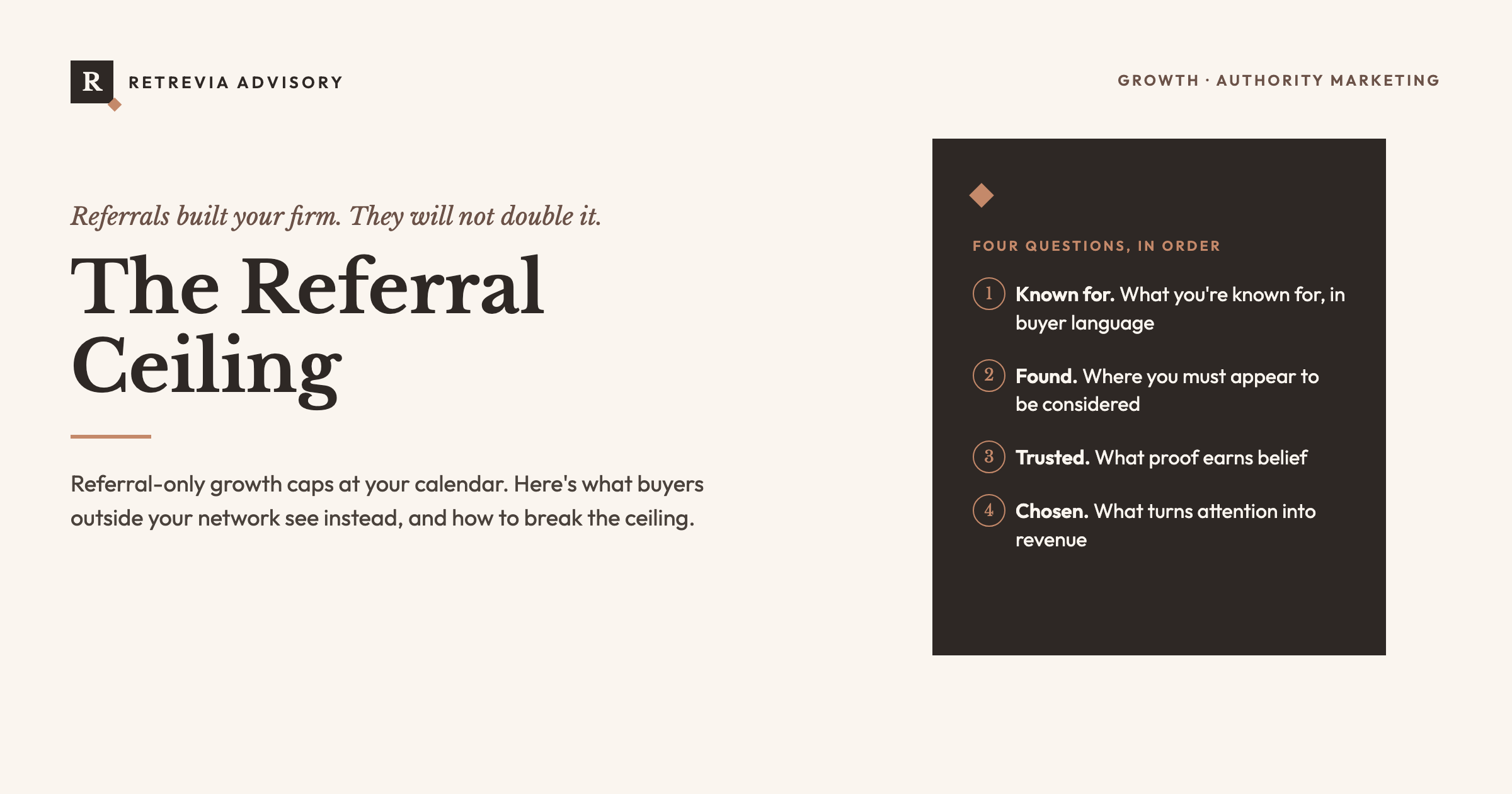
Four Questions, in Order
We work the same four questions with every firm, in this sequence. Skipping ahead is the most common and most expensive mistake.
- Known for. What should your firm be known for, in the words your buyers actually use, not just the words on your website?
- Found. Where must you appear to be considered at all? Search results, AI answers, LinkedIn, industry rankings, directories, or the podcasts and events your buyers pay attention to. Hint: it's a combination.
- Trusted. What evidence, proof pages, third-party mentions, and case studies will make a buyer believe you're worth considering?
- Chosen. How does that attention turn into qualified conversations and revenue you can trace?
Most firms start at question two. They buy activity before they have decided what they are known for, then wonder why the activity does not convert.
How the Authority Marketing System Works
- Market position. We define your highest-value buyer situations, your point of view, and the proof required. Written in buyer vocabulary, not firm jargon.
- Authority engine. You talk. We turn your expertise into the articles, pages, and proof assets that earn trust. Nothing publishes under your name without your thinking in it.
- Distribution system. We operate your priority mix across website, LinkedIn, AI and traditional search, podcasts and speaking, earned media, and sales outreach.
- Revenue connection. Tracking, conversion paths, CRM reporting, and a monthly revenue-learning process. We help you get smart about what activities lead to real revenue, so you can do more of what works.
We Have Run This Play Before
My co-founder Beth Mazza and I executed an SEO (search engine optimization) strategy inside a boutique consulting firm, Clermont Partners. Not a casual investment. We brought in an agency, rewrote the positioning, and rebuilt every piece of content around a real point of view. We saw progress after about 6 months, and it took three years before the full payoff landed.
By the time the firm sold, roughly half of new business was coming in through inbound leads. People found us, vetted us, and reached out.
The channel has changed since then. The principle has not. If the buyer who needs exactly what you do cannot find you when they go looking, that revenue goes to someone else. For more on how that channel works today, read why your firm isn't getting inbound leads.
Start With a Baseline
Before any of this, you need to know where you stand. Retrevia's Brand Visibility Audit assesses your firm from the outside, the way a buyer would: what you appear to be known for, where you show up in search results and AI answers, and what evidence a buyer finds when they check you out.
Then we sit down with you and your numbers for the fourth question: where your clients actually come from today, defining how much of your growth depends on you personally.
If eight of your last 10 clients came through your network, the audit tells you exactly what it would take to change that.
The Referral Ceiling Does Not Lift on Its Own
The firms breaking past their referral ceiling are not the ones with the biggest networks. They are the ones who decided to be found by buyers who were never going to get an introduction in the first place. That takes a market position, an authority engine, a distribution system, and a way to trace it back to revenue. Referrals alone were never going to build all four.
In executive coaching the ceiling takes a specific shape: the site is written to the leader you would coach, while the person who actually builds the shortlist is someone else entirely. We unpack that in what buyers look for in an executive coach.
Where Retrevia comes in
We help founder-led professional services firms build the second pipeline: the one that runs on authority marketing instead of your calendar. The Brand Visibility Audit is the first step. We tell you exactly how much of your growth depends on you personally, and what it would take to change that.
P.S. If eight of your last 10 clients came from your network, let's talk about how you can change that.
Frequently Asked Questions
What is a referral ceiling?
A referral ceiling is the growth limit created when nearly all new business comes from your existing network. Referral volume is a function of relationships you maintain personally, so revenue growth stops when your calendar does. Most founder-led professional services firms hit this without recognizing it as a structural problem rather than a sales problem.
Why does AI search matter for professional services firms specifically?
Because the B2B buyer journey has changed, buyers now assemble a shortlist before making contact. AI answers return four to seven names rather than a page of links. There is no second page to scroll. Your firm is in the answer, or it is not. If it is not, you never learn the opportunity existed.
Can a small firm compete with national brands in AI search?
On broad category questions, it's difficult. Those slots belong to firms with decades of citations. On specific questions that combine industry, role, and city, yes. That is where the national brands drop out and specialist firms surface, and most of those niches have not been claimed on purpose by anyone.
What is authority marketing?
Authority marketing is the practice of establishing your firm as a credible, trusted source in your field, not just through your own content, but through third-party validation: press, podcasts, industry publications, peer recognition, and the search and AI answers buyers see before they ever contact you. It replaces one channel (referrals) with a system that earns trust on its own.
RETREVIA ADVISORY
Your next client is searching now.
Find out if your firm shows up.